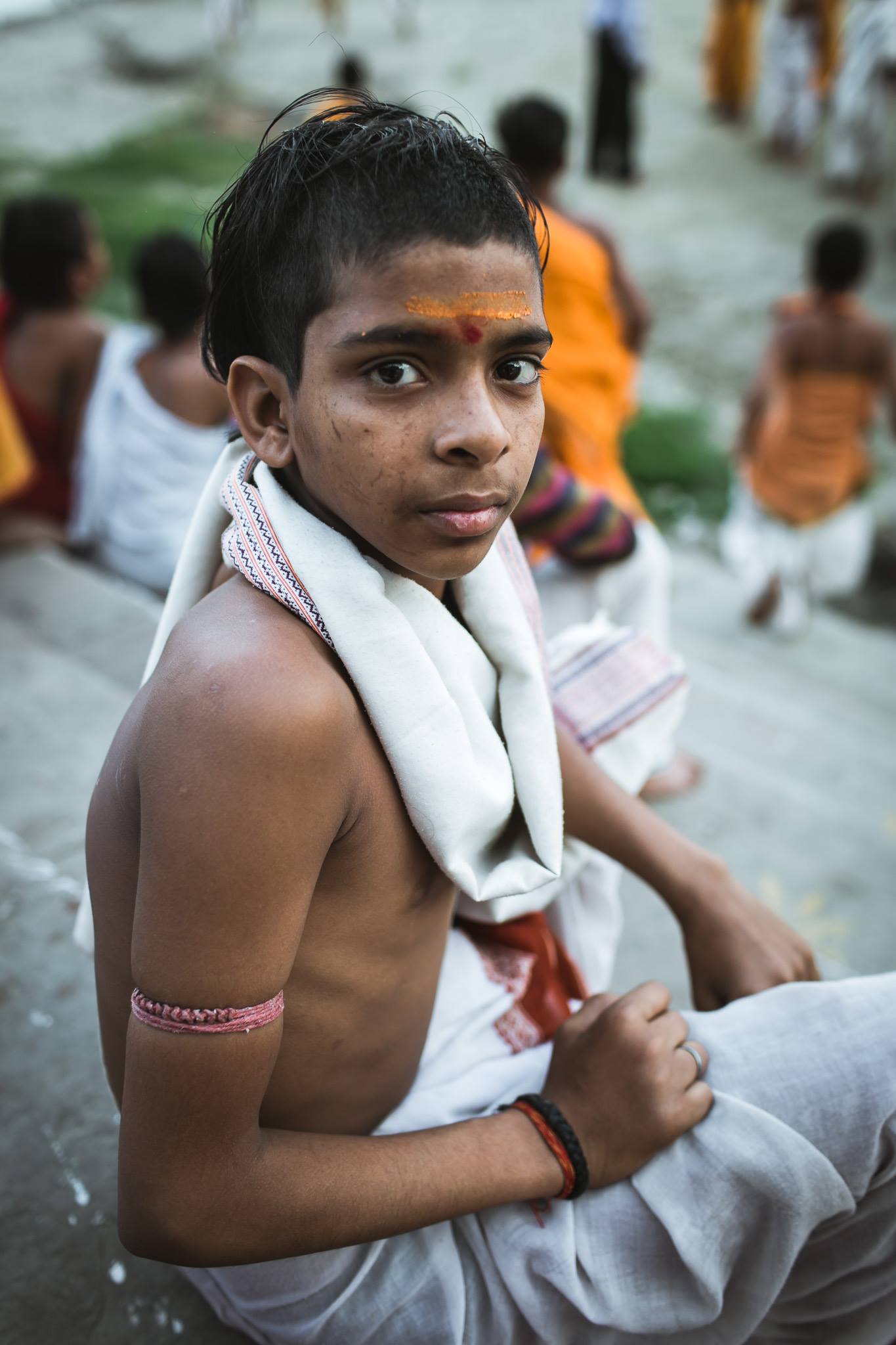
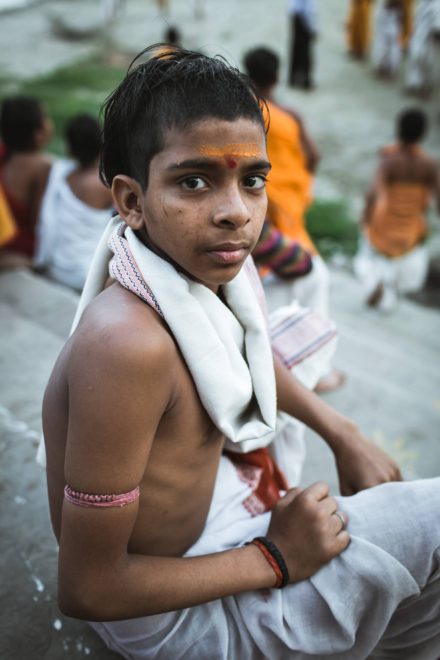
This boy could have been an inventor, a singer, a writer, a creator or a wanderer. But his parents have already chosen a path for him. Here boys come into a new reality and world, where they are groomed and trained to become something that would keep the tradition alive.
I met him in India, surrounded by a culture and tradition that has been passed from one generation to another. I looked at him and wondered what he would become if he were simply allowed to discover that for himself.
He was still a child. He hadn’t yet become the person his family expected him to become. He was simply sitting there, watching the world around him.
And perhaps he had no idea that one day there would be expectations waiting for him. Expectations about who he should become, what he should believe, what work he should do and what kind of life he should live. Everything seems to be planned out for him.
Traditions passed on through generations, cultures kept since the beginning of their time and seeding the youth to a customised way of seeing reality. Where boys become superficial men.
Many children around the world today are told what to do, what to be and how ‘society’ can help them have a better life. In many ways religion and cultures play an important role in creating them, institutionalising them.
So children grow up, learning and playing these roles, these characters, life goals imprinted by others, preaching their paths. In many instance this may be the only way for some children to have a better life, mainly in close knit communities, but it also questions the idea of allowing a child to understand their own path.
I grew up in a Sikh family, as a child, it was hard for me to understand the ideas, rules and values of being a Sikh. Seeing it as a customised way of living, a closed well-cared society, like a one way street. To me life always seems to be in a different view, I felt different than others, so I choose my own path by 16, being away from religion, ceremonies or strict traditions.
Religion, culture, family and society can all become powerful forces in shaping who we become. Sometimes they give us belonging, identity and a sense of where we come from. But sometimes they can also become a set of boundaries that are difficult to question. And I wonder what happens to the child who wants to step outside those boundaries.
I then fell in and out of many different views, trying to relate, trying not to be in guilt or left out of the ‘group’. Growing up in these environments was really hard for someone like me. With whispers of conversations within my family, ‘the black sheep’ they called me.
I often wonder how much of our lives are actually chosen by us. How much of what we call our life was already decided before we were old enough to question it? Our parents teach us. Our communities teach us. Our schools teaches us. Religion teaches us. Culture teaches us. And slowly, we learn how to become the person everyone expects us to be.
Today I’m aware of who I am, institutions doesn’t play a main role in my life anymore, I choose to experience more about religions, cultures and spirituality, to understand on my own, I choose to be close to my heritage. I love my Indus Valley roots and different cultures I’ve inherited throughout my journey, my own understanding of what it is, as I choose not to allow another person tell me how I should live, what I should feel or how I can be in peace with myself. I know what it feels like to be detached from it, but the same time embracing it. As one.
I choose a spiritual way of life. Knowing and not knowing too. Within something and nothing.
I do not feel there is a right or wrong way of seeing this, we practice life in ways we are thought. The self awareness of knowing and learning first, to give the option to explore more knowledge of the universe itself. All the realities and dimensions.
Not just one dimension of the story. Do we appoint ourselves to become preachers of life or allow our children the right to their own path or knowledge in life too?
I don’t know what became of this boy. I don’t know whether he followed the path his family had chosen for him. Perhaps he did. Perhaps he became something completely different. I only had a moment with him. But sometimes a photograph stays with you because it makes you wonder about the life that continued after you left.